4 May 2026
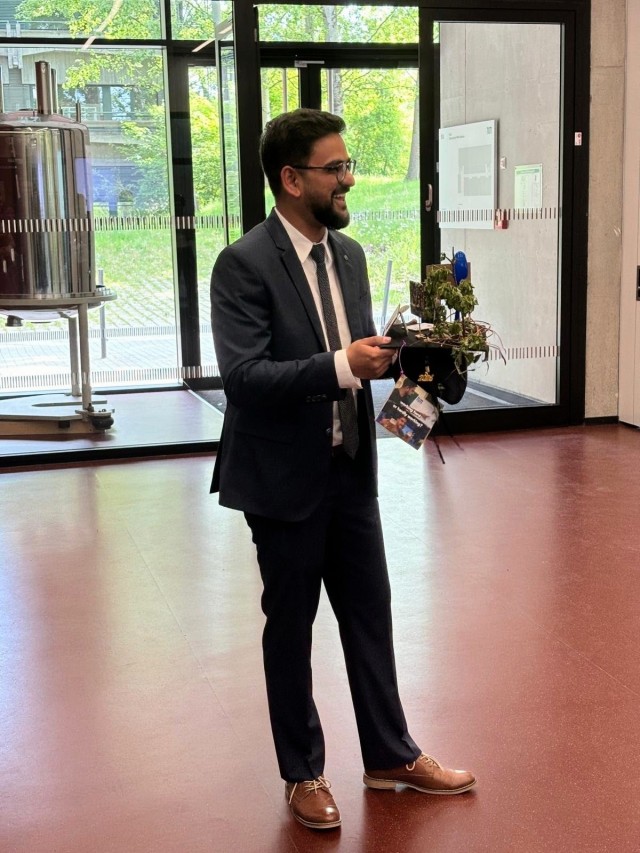
We spoke to Amit Devra, Scientific Program Lead Quantum Computing for the Munich Quantum Valley (MQV) and Scientist. In this interview, Amit Devra shares insights from his career in quantum science, reflecting on the experiences and decisions that have shaped his professional journey.
How did you get into quantum science?
Honestly, although my grades weren’t great during my time at first year of university, I decided to give physics a chance. During a summer internship, I got into the basics of quantum physics, and the following summer I worked on quantum computing with NMR. I met Steffen Glaser at a conference, and that connection led me to Munich and eventually to Munich Quantum Valley (MQV).
I joined MQV in January 2022, while I was still doing my PhD. At the time, I was about 30% focused on MQV and 70% on research. Steffen, one of the initiative's leading figures and an important mentor to me, asked me to take on the role of Scientific Manager. I finished my PhD two years ago, working on quantum algorithms in close collaboration with experimentalists, and I’ve continued to combine research with scientific management.
Did you know during your PhD what you wanted to do afterwards?
Not really. I knew I wanted to do a PhD and develop a strong understanding of the field, but I didn’t want to stress too much about what came next. I focused on doing the PhD as well as possible, building connections with colleagues, and exploring different opportunities.
I also knew quite early on that I didn’t want a purely academic career. I was interested in developing technologies that could have real applications in an industrial setting. The quantum computing landscape has changed enormously since I started my PhD. When I began, there were barely any quantum computing companies in Munich; now there are many.
How did your interest in the broader quantum ecosystem develop?
During my PhD, I was part of a European consortium called QuSCo (a European Union-funded Innovative Training Network), which brought together around 15 PhD students working on topics including optimal control, quantum computing, and sensing. We met regularly at conferences and workshops, and it gave me a strong international network and opportunities to exchange ideas with researchers working in different directions.
MCQST also played a big role. I was very active in the community and regularly attended MCQST conferences and events. These experiences helped me build connections beyond my own research and explore the wider quantum ecosystem.
How did you get into scientific management?
It really started with good mentorship. My supervisor Steffen noticed that I enjoyed networking and working across different areas and suggested that scientific management might suit me. Without him asking, I probably wouldn’t have considered it!
What I find interesting is that management gives you a completely different perspective. As a PhD student, you naturally focus on your own research. In management, you have to look at the bigger picture: what other people are working on, how different areas fit together, and how you can bring people and ideas together.
What makes your current role challenging? Which skills have been most valuable in your role?
There’s always something new to learn. My role has become much broader than a single research project or consortium. It involves strategy, planning, writing proposals, and thinking about how the different parts of the quantum ecosystem fit together. Technically, it’s important to look beyond your own field and keep up with what is happening across quantum computing and related areas. You need to be able to understand new developments and think about what they mean for MQV.
MQV brings together people working across the full stack of quantum computing, from hardware and software to applications. As a manager, you need to understand enough of all these areas to see where different teams are strong and how they can work together more effectively. You’re also working with people from very different backgrounds: computer scientists, electrical engineers, physicists and mathematicians – being able to communicate with people from different disciplines is probably the most important!
What’s your favourite thing about your job?
I like being able to look at many different aspects of quantum computing and think about how we can make the whole ecosystem successful. And, of course, having good colleagues makes a huge difference. Good working relationships and the human element can take a lot of the stress out of a difficult day. Also, we have a very good coffee machine!
What kept you motivated during difficult phases of your PhD?
During COVID, when I wasn’t going to work every day, it became difficult to stay motivated. What helped was reminding myself why I had started in the first place and asking whether that motivation was still there.
If your motivation has genuinely changed, it’s okay to choose something else. But if the reasons are still there, even when things are difficult, then you have to keep going.
What are you most excited about for MQV-II?
I’m excited about working with the team and thinking about the next five to ten years: What are the most important developments in quantum computing? Where should we focus our efforts? And how can we make sure that MQV continues to adapt as the field develops so quickly?
Ultimately, I’d love to see a whole cluster of quantum computing companies and research in Munich – not just more people working on quantum, but real progress on solving hard problems that could impact the industry. We want to build an ecosystem where talented people want to come to Munich, and where they want to stay. If we can build that, that would be pretty cool.