4 May 2026
We spoke to Irene Papaefstathiou, recently appointed Quantum Solutions Lead at Qoro Quantum in April 2026. Irene, originally from Cyprus, did her PhD in the Theory Group at the Max-Planck Institute for Quantum Optics, under the supervision of Ignacio Cirac and Mari-Carmen Banuls. During her PhD, she focused on tensor network numerics for lattice gauge theories. Irene then joined Moody’s as a Quantum Computing Engineer, where she started as an intern in June 2023, working part-time alongside her PhD, before starting with them full-time. Irene was at the MCQST Conference in 2025 and gave a really valuable talk about her career experience – for those of you who couldn’t attend her talk, we also interviewed her, so that you can also enjoy hearing her career insights!
Congratulations on your new position! What would you say is what you are most looking forward to in this next step of your career?
I am really excited to be part of Qoro’s mission in building the access layer for heterogeneous computing networks, gluing together CPUs, GPUs and quantum processors. Think of a platform that you can use to build hybrid quantum-classical workloads. This enables developers and scientists to build hybrid applications with only a few lines of code. Having worked on quantum applications in finance before, I have experienced first-hand how important it is to get all the benefits from heterogeneous computing and automation for boosting efficiency. In many ways, what Qoro has built what I wished I'd had back then; working on quantum applications has never been more accessible.
I also love the fact that I work for a start-up with people that are very passionate and committed to the work they do.
What is your role now about?
I am a Quantum Solutions Lead, which means I get to work on real industrial problems, such as in finance or energy, using Qoro’s platform for hybrid quantum-classical workloads. I also engage in applied research engagements with other companies or academic collaborators. That means co-authoring publications, representing Qoro at conferences and workshops, working with partners from initial problem scoping to developing proofs of concept etc. I love the fact that the role has both a technical aspect as well as allowing me to meet and collaborate with a lot of people.
What has been the main difference in the working process in industry versus in academia?
The projects are fast paced and shorter in length – several months instead of several years! I really enjoy this aspect of it. At Moody’s, my main work was applying known algorithms to financial use cases, and it was really exciting to solve many problems and get results from my work relatively quickly.
Another difference is that there is a more developed time plan to my projects, which are very well organised. We have goals and deadlines, and regular meetings with our managers. Our projects are less open ended than what I experienced in academia, and the types of projects I can choose have to be applied to a use case that company is interested in.
However, there are also some similarities to academia - everyone is working independently, and we have a lot of freedom in how we work, which I really like. We give major updates at seminars where we can also discuss open problems or work together.
What advice would you give to PhD students at the start of their degree?
When you start your PhD, be open minded about your experience! What I mean by this is, remember that if you’ve only ever studied at university, then you haven’t actually explored the job market, and the only thing you know is the academic environment and how academia works. For me, for example, it was a natural path to go into a PhD, since I didn’t know that anything else existed! A lot of students aspire to a career in academia, and then if they realise they want to move on to something else, this can lead to them feeling a bit lost. So, this is my advice, to be open minded to other paths and experiences. First and foremost, your PhD is a degree qualification, and it will help you with whatever you choose to do next. I really recommend looking for internships and other experiences early on to explore!
Another piece of advice is to not to compare yourself to other people because the PhD experience and your project is unique for each and every one of us. There is really no point of comparison, as there are just too many factors that contribute: luck, your project, your environment, etc... If you feel you do need some form of comparison, then it’s better to compete with your past self and try to be in a state of learning.
I also learned how important a support system was, and to ask for help early on. This is especially important to protect mental health! In your PhD, you have to redefine the measure of success compared to university studies, since it doesn’t come from exam results and grades. It really helps to have a community, a support system, to talk to!
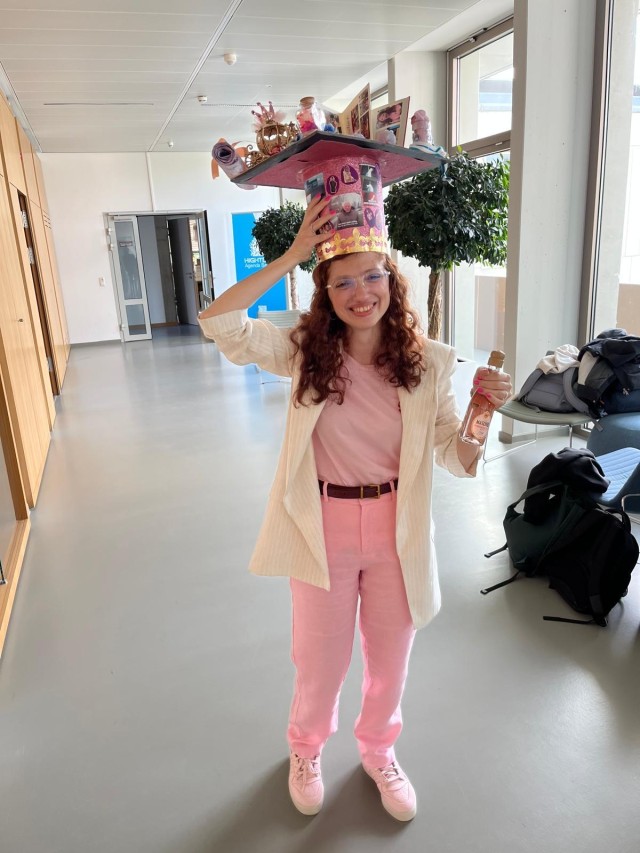
What are some of your favourite memories from your PhD?
The happiest memories during my PhD are linked to the many extraordinary people I’ve met along the way! They have been amazing, intelligent people. One particularly special memory was the Group Hackathon we held at the top of Zugspitz, where we went skiing at an altitude that I have never been in my life. It felt like a once-in-a-lifetime experience - the hackathon had such a vibrant, collaborative atmosphere, a team of people working together in this amazing place, solving physics problems together.
What’s been your experience of the effect of diversity in careers in quantum?
I realized that having a diverse environment, in every sense, like gender and internationality, really helps me to excel. In my PhD I developed a great support system of amazing and intelligent women around me, and later I noticed that it felt great to me when a lot of women were suddenly hired.
What is Girls in Quantum?
"Girls in Quantum" is an amazing outreach initiative that aims to promote quantum science and technology education among women in high school and underrepresented groups around the world. The focus is on creating a more inclusive, diverse, and accessible environment within the rapidly growing field of quantum computing and quantum technologies. The core team includes young students from places including Germany, Bangladesh and the USA. The organization provides curated resources on quantum mechanics, talks with experts from academia and industry, and also mentorship opportunities! It’s pretty incredible what these young students have achieved. I met some of the core team members at a conference in London and now I’m actually on the advisory board! This is a topic I’m extremely passionate about, so I’m happy to be a part of it.