21 January 2026
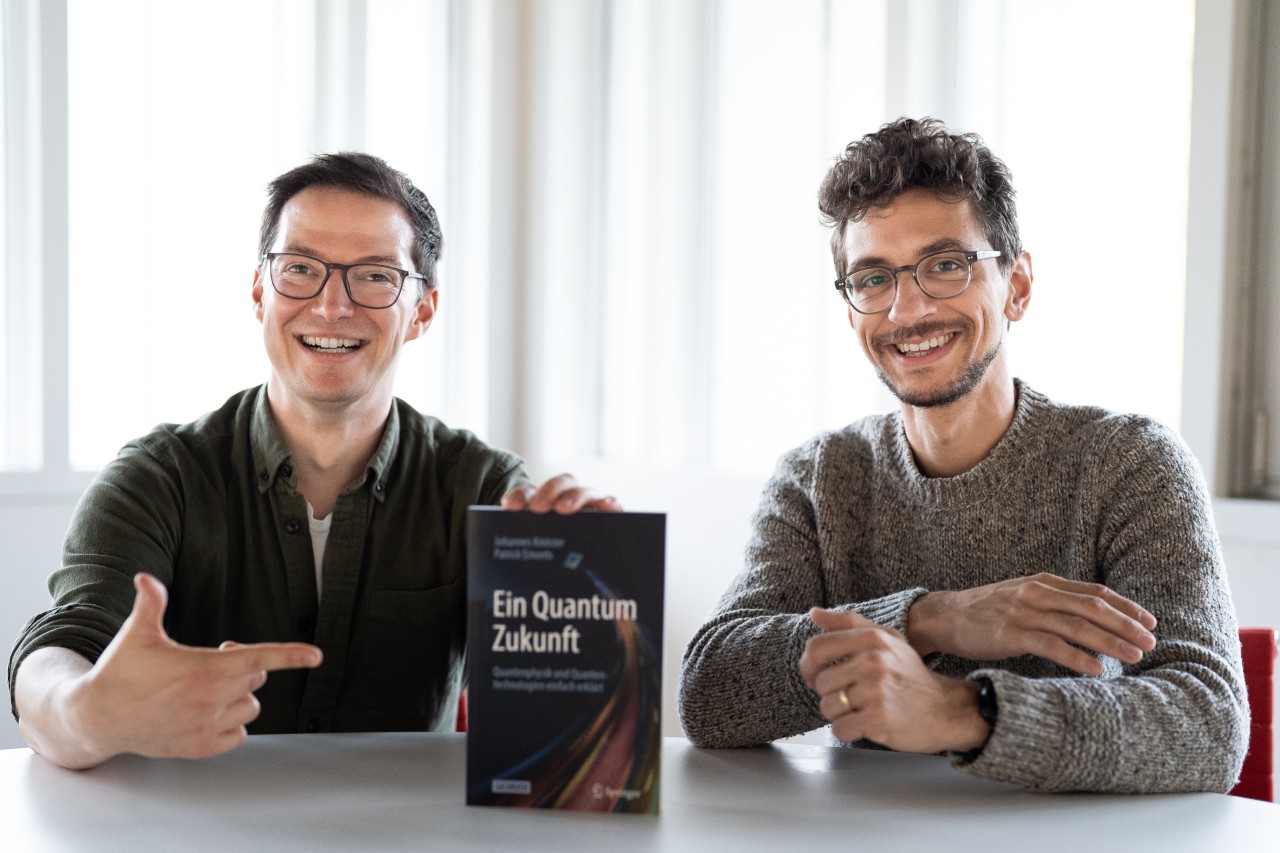
When MCQST alumni Patrick Emonts (TUM) and Johannes Knörzer (LMU) set out to write Ein Quantum Zukunft, a popular science book on quantum technologies, they didn’t expect it would take them on a two-year journey from the classroom, to conferences, and countless drafts. We sat down with them to talk about how it all began, and what it takes to bring quantum science to life on the page.
Q: First things first — what’s the story behind how you started your book?
Johannes: When I wrote my PhD thesis at LMU, I realised how much I enjoy writing and thinking about the “big picture”. I thought it would be great to write something like that — and for me, Patrick was the obvious person to do it with! We had already taught together at the Deutsche Schülerakademie where we ran a two-and-a-half-week course on quantum computing for German high school students. We loved explaining and teaching together — and we prepared a lot, but also learned to embrace the spontaneous moments, improvising off of each other. That experience really shaped how we wrote the book, and had a lot of fun doing so!
Patrick: I actually went to the Akademie myself as a student, and it felt really rewarding to later teach there myself. Writing the book is yet another way to be giving back.
Q: Why write another book on quantum?
Patrick: We wanted to write something that our Grandmas would want to read! We noticed that in the German-speaking market, there weren’t many books covering quantum technologies beyond computing. We wanted to fill that gap — and make something that is for anyone curious about science, maybe someone who enjoys a visit to the Deutsches Museum.
Johannes: You don’t need a deep mathematical background to read this book. Nevertheless, we actually wanted to explain the physics properly. We use a lot of analogies to help make the concepts accessible — like cooking recipes for quantum algorithms, or frogs jumping up ladders for atomic energy levels.
Q: How did you actually get it published?
Johannes: We started writing in 2022 and sent sample chapters — about 30 pages — to publishers the following year. Springer replied right away and said yes. That was a huge moment. After that, we spent around 18 months writing and revising. We handed in the final manuscript in March 2025.
Q: Can you tell us a bit about the writing process?
Patrick: We were both super committed to the process, to our own deadlines and to communicating with each other often. We once had a memorable meeting in Leiden where we wrote down pretty much our whole plan for the book on sheets of paper and mapped it out on the floor! Later, we would often meet at conferences, since both of us are researchers, and meeting in person led to a lot of great discussion.
Johannes: Writing is fun for us, and we both enjoy literature. We were committed to writing something really didactic, finding a way to express concepts in a way that is both technically accurate and still fun to read! For example, we only include two equations, as absolutely necessary. The learning process needs a balance of both rigour and fun to really stick for a general audience. We also realised that repetition is key in this respect.
Patrick: Some chapters were written really quickly, while others were rewritten several times. For example, the section on entanglement? Four versions! We merged our writing styles, which are quite different — one of us writes long sentences, the other short — but in the end, we found a common voice.
Q: What makes you most proud?
Patrick: Two moments stand out. Presenting the book in Zurich, when Johannes’s brother couldn’t stop reading it for 90 minutes — forgetting the world around him. And at the Quantum Effects trade fair, a PhD student told me he’d been reading it for hours and finally understood the “big picture”. That makes all the effort worth it!
Q: Finally, tell us about the title — Ein Quantum Zukunft.
Johannes: It captures our cautiously optimistic view of where quantum technology is heading. There’s so much potential from the technological and scientific perspective — and also plenty of open questions, including from the market perspective.
Patrick: Exactly. It’s about being positive while staying realistic — and curious about what’s next.
"Ein Quantum Zukunft" is published by Springer and available in bookshops now. An English translation is in the works — stay tuned for more at an upcoming MCQST event!
About Patrick & Johannes
Patrick Emonts is a Junior Research Group Leader at the Institute for Complex Quantum Systems at Ulm University, where he leads his own group working on quantum information and lattice gauge theories, since April 2025. Previously, he was a postdoctoral researcher in the Applied Quantum Algorithms (aQa) group at Leiden University, where he is currently also a guest lecturer. He completed his PhD in Physics in 2022 at the Max Planck Institute of Quantum Optics and the Technical University of Munich, working in the group of Ignacio Cirac on tensor network algorithms for Hamiltonian lattice gauge theories.
Johannes Knörzer is part of the Superconducting Circuits team of the ETH Zurich - PSI Quantum Computing Hub. He joined the Quantum Device Lab as a Postdoc in February 2025. Previously, he was a Junior Fellow at the Institute for Theoretical Studies at ETH Zurich. He has worked on topics at the interface of quantum information, quantum optics and condensed-matter physics. He received his PhD from the LMU Munich and the Max Planck Institute of Quantum Optics under the supervision of Ignacio Cirac, where he worked on quantum simulation and semiconductor-based quantum information processing.